


Ramadan is a time of patience, worship, and unity, but for many low-income families in Punjab, it also brings financial pressure due to rising food prices. To reduce this burden, the Punjab Government has introduced 9999 Ramzan Relief 2026, linking all major Ramadan support programs with the PSER Survey 2026. This system ensures that assistance reaches only deserving households in a fair and transparent manner.
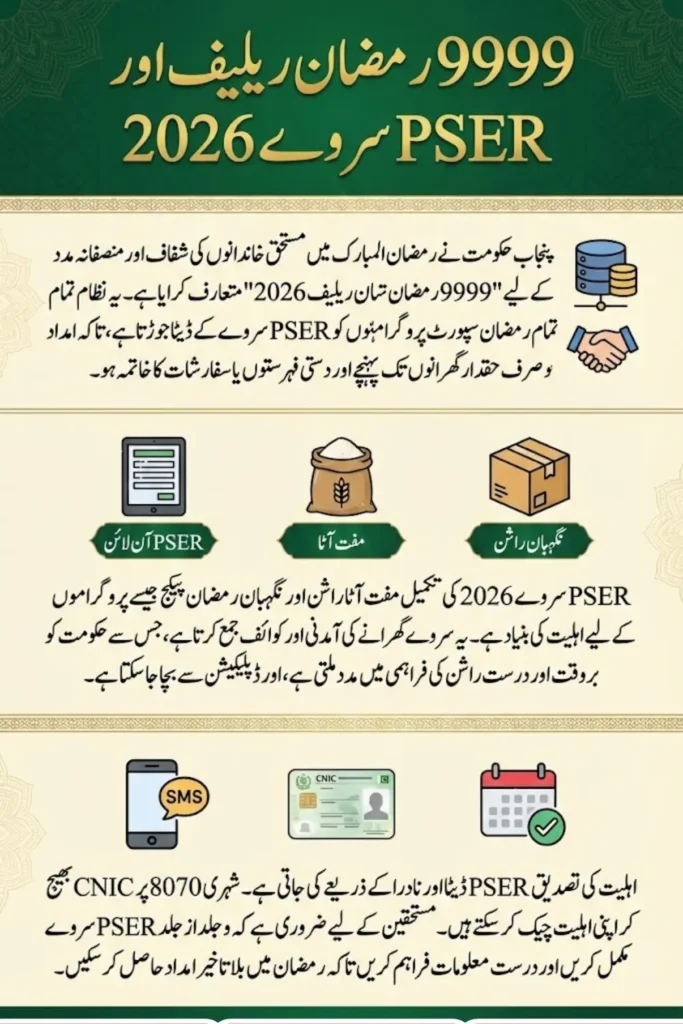
This year, completing the Punjab Social and Economic Relief (PSER) Survey is essential to qualify for Ramadan support programs such as Muft Atta Rashan, Ramzan Rashan Package, and the Negahban Ramadan Package. The survey creates a verified household database that helps the government deliver ration support on time without confusion or misuse.
What Is 9999 Ramzan Relief 2026 and Why It Matters
The 9999 Ramzan Relief 2026 is a combined welfare framework designed to connect household data with Ramadan assistance. Instead of manual lists or political recommendations, relief distribution is now based on verified data collected through PSER and government surveys.
You can also read: PSER Registration 2026 Opened
This approach improves transparency and ensures equality in distribution. Every household is assessed using the same criteria, which helps eliminate fraud and duplication while strengthening public trust in welfare programs.
Key goals of the 9999 Ramzan Relief include
- Accurate identification of deserving families
- Fair and need-based ration distribution
- CNIC-based verification to prevent misuse
- Reduced dependence on offices and long queues
Understanding the PSER Survey 2026
The PSER Survey 2026 is a household-level data system developed by the Punjab Government. It collects information related to income, family size, living conditions, and financial dependency. This data becomes the foundation for deciding eligibility for all Ramadan relief initiatives.
Families can complete the PSER survey either online or through the Ghar Ghar Survey, ensuring inclusion of households without internet access. Once submitted, the information is digitally verified through NADRA and other official welfare databases.
The PSER survey helps the government
- Build a reliable welfare database
- Identify low-income households accurately
- Avoid repeated or fake registrations
- Link families to multiple relief programs
PSER Survey Online Registration Process 2026
The PSER online registration process is simple and accessible for everyone. Applicants can complete the survey from home using a mobile phone or computer without paying any registration fee.
Providing correct information is extremely important. Incorrect CNIC or income details can lead to rejection or delays during verification.
Steps to complete PSER online registration
- Visit the official PSER portal
- Select the online registration option
- Enter CNIC and personal information
- Provide household income and family details
- Submit the form and save confirmation
After submission, the data is reviewed and approved before Ramadan relief benefits are assigned.
Ramadan Relief Programs Connected With PSER
Once a household completes the PSER survey, it becomes eligible for several Ramadan support programs. All relief initiatives use PSER data as the primary eligibility source.
Relief programs linked with PSER include
- Ramzan Rashan Package
- Muft Atta Rashan Program
- Negahban Ramadan Package
- Future Punjab welfare initiatives
This system ensures that families receive support based on verified need rather than repeated applications.
Muft Atta Rashan Program 2026
The Muft Atta Rashan Program 2026 provides free flour to eligible households during Ramadan. Flour is a daily necessity, and free provision helps families manage rising food costs during the fasting month.
Eligibility for free atta is fully dependent on PSER survey data. CNIC verification ensures that only approved families can collect flour from designated distribution points.
Important features of Muft Atta Rashan
- Eligibility determined through PSER survey
- CNIC-based verification system
- Free flour from assigned centers
- No application or collection fee
You can also read: Punjab Ramzan Package 2026
Negahban Ramadan Package 2026
The Negahban Ramadan Package 2026 is a doorstep ration delivery program for deserving families in Punjab. It is designed to eliminate long queues and ensure dignified support during Ramadan.
Registration for this package is completed through door-to-door surveys conducted by official government teams. Household data is verified digitally before ration delivery.
Items included in the Negahban Rashan package
- Flour
- Rice
- Ghee
- Basic grocery items
The quantity may vary slightly by district, but essential items remain the same.
Eligibility Verification and SMS Check Method
Eligibility for 9999 Ramzan Relief 2026 is verified using PSER data combined with NADRA, BISP, and other welfare records. This multi-layer verification system prevents duplication and ensures fairness.
Families can check Negahban Ramadan Package eligibility from home.
Eligibility check steps
- Send CNIC number to 8070
- Wait for confirmation SMS
- Eligible families receive ration delivery updates
PSER and Negahban Program Comparison
| Feature | PSER Survey 2026 | Negahban Ramadan Package 2026 |
|---|---|---|
| Purpose | Identify deserving households | Provide free Rashan |
| Registration Method | Online & Ghar Ghar Survey | Door-to-door survey |
| CNIC Requirement | Mandatory | Mandatory |
| Relief Type | Atta & Rashan eligibility | Doorstep Rashan |
| Eligibility Check | Survey-based | SMS via 8070 |
Important Instructions for Beneficiaries
Families should cooperate with survey teams and stay alert for official SMS notifications. Keeping CNIC information updated is essential for approval and timely ration delivery.
Important guidelines for beneficiaries
- Complete PSER survey as early as possible
- Provide accurate household information
- Do not share CNIC with unauthorized individuals
- Follow official government instructions only
You can also read: 8070 Registration Web Portal
Conclusion
The 9999 Ramzan Relief 2026, supported by the PSER Survey, represents a major improvement in welfare distribution across Punjab. Digital registration, door-to-door surveys, and CNIC verification have created a transparent and fair system for Ramadan assistance.
Families who complete the PSER survey on time improve their chances of receiving free ration, flour, and other Ramadan relief without delays. This initiative reflects the government’s commitment to food security and support for deserving households during the holy month.